Skip to content
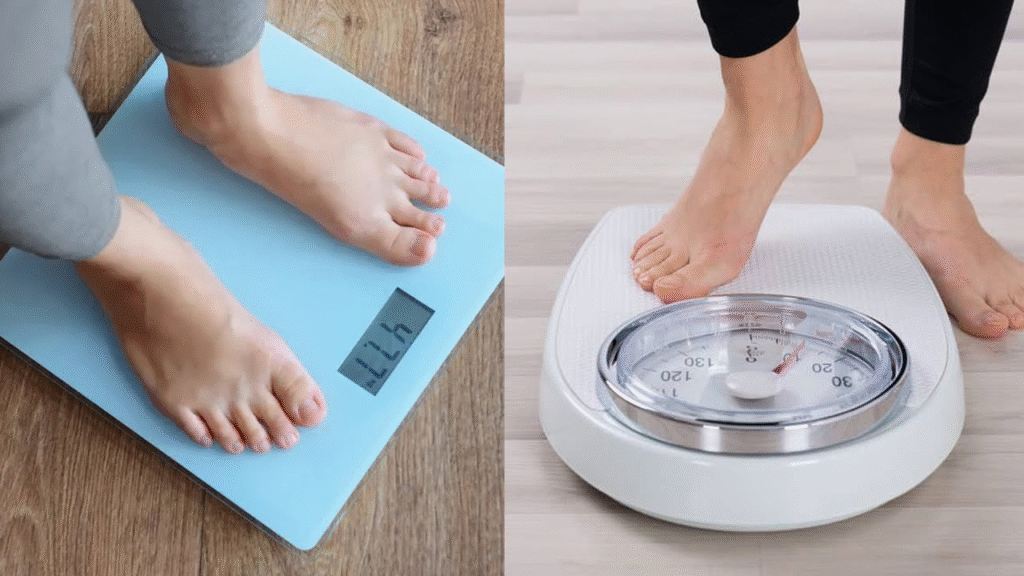
Today, we are living in the era of health-consciousness, and a weighing scale is no longer an average piece of equipment to know one’s weight.
It has become something of a necessity in life in order to track progress, to keep fitness goals ongoing, or even to track health conditions.
Knowing Digital and Analog Scales
Before we go on and contrast these two types of scales, let’s learn about these two types of scales.
Analog scales are the traditional machines that weigh and are mechanical. Analog scales are made up of a round display which rotates when you are placed on the scale and shows your weight. Analog scales don’t use electricity or batteries and are simple and durable.
Analog scales, on the other hand, use mechanical sensors. Weights are indicated on a rotating dial, often with unit conversion, memory capacity, or even Bluetooth connectivity for more sophisticated models. They operate on electricity or batteries and produce weights in decimal points.
Accuracy Comparison Between Digital and Analog Scales

One of the more argumentative differences when placing machines against one another is precision. For the most part, digital scales tend to be more accurate than analog scales.
This is because the advanced electronic sensors that they can use might have been able to detect even small variation in weight.
The analog balances are mechanical spring instruments. Over time, due to constant use, they become less accurate due to repeated wear and tear.
Slow changes in standing in a certain manner or on which surface the balance is placed also affect the measurement.
Ease of Use and Readability
Both digital and analog scales are good in their own way when it comes to simplicity. Analog scales are extremely simple. You just step onto the platform, and your weight is shown on the dial. You do not need to deal with any buttons or controls.
Readability does become an issue with blind people, though. The dial can be compact, and the pointer can be difficult to read precisely.
Electronic scales, however, yield light LCD displays that offer reading in large, legible numbers. Electronic scales also usually include backlit screens, which prove convenient should you plan to use them in a darkened room. There are even some models that allow you to switch units like kilograms, pounds, or stones so that you can utilize them for more than one person.
Design and Features
Aesthetically, electronic balances are lightyears more advanced now. New digital balances are not only sexy and sleek looking but also come with a plethora of features so that they are even more hassle-free than the old school ones.
Some get loaded to send data through Bluetooth or Wi-Fi into your phone apps to track your weight history. Others even do body percentage of fat, BMI, muscle mass, and even water content.
Analog scales don’t quite match the swanky appearance, however. They are still old-fashioned-looking. They take up more space and lack bells and whistles but are adored by individuals who adore the plain and pure.
They are ideal for areas where technology isn’t suitable, such as in certain work environments or areas that have very minimal electricity supply.
Durability and Maintenance
If you want a scale that will last you decades and doesn’t need to be adjusted too often, an analog scale is probably what you are searching for. Since it operates on a mechanical system, there are no parts that can go wrong electronically. You won’t be changing batteries or struggling with the display.
Electronic balances require special care. Batteries must be replaced now and then, and electric sensors are sensitive to water and shock. But with proper maintenance, a good electronic balance lives decades too.
Electronic scales are widely differentiated by price based on what they can do. They may be very low cost in the most elementary models but very expensive in the advanced models with smart features and body composition measurements. The additional cost, however, can be justified for individuals who need precise and comprehensive health monitoring.
Appropriateness for Different Users
The user also has the ultimate authority of whether to use an analog or digital scale. For instance, if the scale will be used by older people who cannot operate a computer or otherwise do not read very small digital values, an analog scale would be best.
To dieters, diet fanatics, or sports persons, an electric scale is more precise and tracks better. Digital scales also come with a couple of user profiles and therefore are suitable for households where there are multiple members who can use one appliance.
Environmental Considerations
From an ecological perspective, analog scales are better off since they contain no electronics or batteries. They hence cause less electronic trash. Technologically more sophisticated digital scales contain batteries that have to be discarded in an eco-friendly manner.
If you are green, this is something to bear in mind. Some newer electronic scales that use rechargeable batteries or solar power are, nonetheless, available, which will be able to reduce their effect.
How to Choose the Ideal Weighting Scale to Use at Home

If you are thinking of balancing the ideal scale to use at home, you will have to balance your own needs, wants, and lifestyle. Here are some tips:
Purpose of Use: You simply require an analog scale if you merely intend to weigh yourself once in a while. But if you require exact data and tracking, a digital scale is the ideal solution.
Features: Consider if you would or would not like added features like calculation of BMI or connection with mobile phone.
Design and Space: In case design matters to you, then digital scales come in slim and modern designs that will fit into most bathroom or bedroom space.
Advantages of Digital Weighing Machines
Digital weighing machines are the best choice because of many reasons. They are accurate, feature-rich and simple to use. Some of the major advantages are as follows:
- High Accuracy: Digital sensors provide accurate and trustworthy readings.
- Easy to Read: Easy to read numbers are presented.
- Multi-Functionality: Digital scales measure something other than weight in the majority of instances.
- User Memory: There are digital scales that contain a memory for more than one user.
- Small and Cool: Digital scales are slim and fashionable.
For someone who wants to track fitness or health, a digital scale gives far greater control and feedback.
When An Analog Scale Is The Better Choice
Notwithstanding the use of the majority of technologies through digital scales, analog scales manage to find their way into every home. Analog scales are simple to use, they are reliable, and they have no power sources. You can utilize them wherever you might be, whenever you want, and you are unlikely to break them.
Analog scales perform extremely well in rugged environments, including gyms or doctor’s offices where constant use can destroy sensitive digital sensors. Heavy-duty construction is best for frequent use.
If you are someone who simply wants something simple and uncluttered, an analog scale could be just what you need.
FAQs:
1. Is a digital scale more accurate?
Electronic scales are more accurate since they use sensors that can detect even minor changes in weight, unlike mechanical scales that use mechanical springs which gradually lose accuracy over time.
2. How do I choose the right house weighing scale?
Consider your needs, desired accuracy, cost, and readability. Tracing accuracy is better in electronic ones, while ruggedness and simplicity are better in mechanical ones.
3. What are the main benefits of electronic weighing scales?
They are accurate, easy to read, will likely have features like BMI testing, and record data for multiple individuals.
4. Are mechanical weighing scales reliable today?
Yes, mechanical balance scales are rugged and long-lasting. They can be used by people who like the simplicity and do not need computerized models.
5. Which would I purchase if I like long term use with no maintenance?
If you like to use a scale over a long term period without batteries or calibration, your best choice would be an analog scale.
Conclusion:
Both of the two scales have their disadvantages and advantages. If spending money on precision, high-tech functions, and fashionable appearances, then a digital scale is for you.